Comparative Evaluation of ITS1, ITS2, and LEAFY (LFY) CDS Markers for Species Discrimination in Asteraceae
DOI:
https://doi.org/10.70158/buitenzorg.v3i1.47Abstract
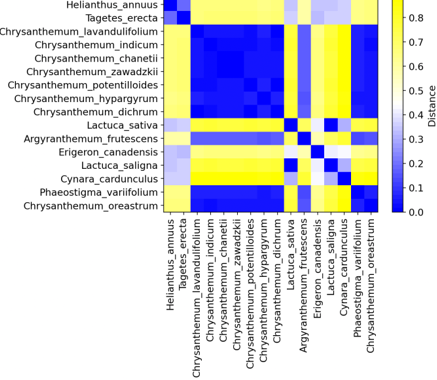
Asteraceae is one of the largest and most diverse angiosperm families, making species identification challenging, especially among closely related taxa with overlapping morphological characters. This study evaluated the performance of ITS1, ITS2, and the coding sequence of the LEAFY (LFY) gene as molecular markers for discriminating selected Asteraceae species and assessing relationships at the genus, tribe, and subfamily levels. Publicly available sequences were retrieved from NCBI databases and curated based on taxonomic identity, marker annotation, sequence quality, and accession consistency. The ITS1, ITS2, and LFY coding sequence (CDS) datasets were aligned separately using MUSCLE in MEGA, followed by sequence variation analysis, Maximum Likelihood phylogenetic reconstruction, and pairwise genetic distance analysis. All three markers recovered broad taxonomic patterns, including the clustering of Chrysanthemum species and the separation of more distant genera such as Helianthus, Tagetes, Erigeron, Cynara, and Lactuca. LFY CDS showed the highest absolute number of variable sites and parsimony-informative sites, followed by ITS2 and ITS1. ITS2 provided slightly greater phylogenetic information than ITS1, while LFY CDS provided an independent nuclear coding signal that complemented the ribosomal ITS markers. Overall, each marker contributed useful phylogenetic information for assessing taxonomic relationships within Asteraceae.
Keywords: Asteraceae, ITS1, ITS2, LFY, DNA barcoding, species discrimination, phylogenetic analysis.
Downloads
References
Álvarez, I., & Wendel, J. F. (2003). Ribosomal ITS sequences and plant phylogenetic inference. Molecular Phylogenetics and Evolution, 29(3), 417–434. https://doi.org/10.1016/S1055-7903(03)00208-2
Awaliah, S. R., & Polosoro, A. (2024). A comparative study of DNA barcoding markers for Bamboo. Buitenzorg: Journal of Tropical Science, 1(2), 30–41. https://doi.org/10.70158/buitenzorg.v1i2.9
Bailey, C. D., Carr, T. G., Harris, S. A., & Hughes, C. E. (2003). Characterization of angiosperm nrDNA polymorphism, paralogy, and pseudogenes. Molecular Phylogenetics and Evolution, 29(3), 435–455. https://doi.org/10.1016/j.ympev.2003.08.021
Baum, D. A., Yoon, H. S., & Oldham, R. L. (2005). Molecular evolution of the transcription factor LEAFY in Brassicaceae. Molecular Phylogenetics and Evolution, 37(1), 1–14. https://doi.org/10.1016/j.ympev.2005.07.002
CBOL Plant Working Group. (2009). A DNA barcode for land plants. Proceedings of the National Academy of Sciences of the United States of America, 106(31), 12794–12797. https://doi.org/10.1073/pnas.0905845106
Chen, S., Yao, H., Han, J., Liu, C., Song, J., Shi, L., Zhu, Y., Ma, X., Gao, T., Pang, X., Luo, K., Li, Y., Li, X., Jia, X., Lin, Y., & Leon, C. (2010). Validation of the ITS2 region as a novel DNA barcode for identifying medicinal plant species. PLOS ONE, 5(1). https://doi.org/10.1371/journal.pone.0008613
China Plant BOL Group. (2011). Comparative analysis of a large dataset indicates that internal transcribed spacer (ITS) should be incorporated into the core barcode for seed plants. Proceedings of the National Academy of Sciences of the United States of America, 108(49), 19641–19646. https://doi.org/10.1073/pnas.1104551108
Edgar, R. C. (2004). MUSCLE: Multiple sequence alignment with high accuracy and high throughput. Nucleic Acids Research, 32(5), 1792–1797. https://doi.org/10.1093/nar/gkh340
Elomaa, P., Zhao, Y., & Zhang, T. (2018). Flower heads in Asteraceae—Recruitment of conserved developmental regulators to control the flower-like inflorescence architecture. Horticulture Research, 5, 36. https://doi.org/10.1038/s41438-018-0056-8
Gao, T., Yao, H., Song, J., Zhu, Y., Liu, C., & Chen, S. (2010). Evaluating the feasibility of using candidate DNA barcodes in discriminating species of the large Asteraceae family. BMC Evolutionary Biology, 10, 324. https://doi.org/10.1186/1471-2148-10-324
Gao, B., Chen, M. X., Li, X. S., & Zhang, J. H. (2019). Ancient duplications and grass-specific transposition influenced the evolution of LEAFY transcription factor genes. Communications Biology, 2, 237. https://doi.org/10.1038/s42003-019-0469-4
Grob, G. B. J., Gravendeel, B., & Eurlings, M. C. M. (2004). Potential phylogenetic utility of the nuclear FLORICAULA/LEAFY second intron: Comparison with three chloroplast DNA regions in Amorphophallus (Araceae). Molecular Phylogenetics and Evolution, 30(1), 13–23. https://doi.org/10.1016/S1055-7903(03)00183-0
Hao, D., Song, Y., Xiao, P., Zhong, Y., Wu, P., & Xu, L. (2022). The genus Chrysanthemum: phylogeny, biodiversity, phytometabolites, and chemodiversity. Frontiers in Plant Science, 11,13:973197. https://doi.org/10.3389/fpls.2022.973197
Hollingsworth, P. M., Graham, S. W., & Little, D. P. (2011). Choosing and using a plant DNA barcode. PLOS ONE, 6(5), e19254. https://doi.org/10.1371/journal.pone.0019254
Kumar, S., Stecher, G., Suleski, M., Sanderford, M., Sharma, S., & Tamura, K. (2024). MEGA12: Molecular Evolutionary Genetic Analysis version 12 for adaptive and green computing. Molecular Biology and Evolution, 41(12), msae263. https://doi.org/10.1093/molbev/msae263
Liu, P., Wan, Q., Guo, Y., Yang, J., & Rao, G. (2012). Phylogeny of the genus Chrusanthemum L.: evidence from single-copy nuclear gene and chloroplast DNA sequences. PLOS ONE, 7(11). https://doi.org/10.1371/ journal.pone.0048970
Panero, J. L., & Funk, V. A. (2002). Toward a phylogenetic subfamilial classification for the Compositae (Asteraceae). Proceedings of the Biological Society of Washington, 115(4), 909–922.
Sang, T. (2002). Utility of low-copy nuclear gene sequences in plant phylogenetics. Critical Reviews in Biochemistry and Molecular Biology, 37(3), 121–147. https://doi.org/10.1080/10409230290771474
Sayers, E. W., Cavanaugh, M., Clark, K., Pruitt, K. D., Sherry, S. T., Yankie, L., & Karsch-Mizrachi, I. (2024). GenBank 2024 update. Nucleic Acids Research, 52(D1), D134–D137. https://doi.org/10.1093/nar/gkad903
Schoch, C. L., Ciufo, S., Domrachev, M., Hotton, C. L., Kannan, S.,
Khovanskaya, R., Leipe, D., McVeigh, R., O’Neill, K., Robbertse, B., Sharma, S., Soussov, V., Sullivan, J. P., Sun, L., Turner, S., & Karsch-Mizrachi, I. (2020). NCBI Taxonomy: A comprehensive update on curation, resources and tools. Database, 2020, baaa062. https://doi.org/10.1093/database/baaa062
Zhang, R., Stull, G. W., Jin, J., Wang, Y., Guo, Y., Yang, Z., Li, H., An, K., Charboneau, J. L. M., Folk, R. A., Cardoso, D., Queiroz, L. P. D., Bruneau, A., Soltis, P. S., Soltis, D. E., Smith, S. A., Li, D., & Yi, T. (2026). Genetic resolution and conflict in the species-rich flowering plant family Leguminosae. Systematic Biology, 236-258.
Zhao, Y., Zhang, T., Broholm, S. K., Tähtiharju, S., Mouhu, K., Albert, V. A., Teeri, T. H., & Elomaa, P. (2016). Evolutionary co-option of floral meristem identity genes for patterning of the flower-like Asteraceae inflorescence. Plant Physiology, 172(1), 284–296. https://doi.org/10.1104/pp.16.00779
Downloads
Published
How to Cite
Issue
Section
License
Copyright (c) 2026 Buitenzorg: Journal of Tropical Science

This work is licensed under a Creative Commons Attribution-ShareAlike 4.0 International License.
The article is licensed under a Creative Commons Attribution-ShareAlike 4.0 International License (CC BY-SA), which allows both Authors and Readers to copy and distribute the material in any format or medium, as well as modify and create derivative works from it for any purpose, provided that appropriate credit is given (by citing the article or content), a link to the license is provided, and it is indicated if any changes were made. If the material is modified or used to create derivative works, the contributions must be distributed under the same license as the original.