Studi Dasar Nepenthes spp. di Taman Wisata Alam Bukit Tangkiling, Palangka Raya, Kalimantan Tengah, Indonesia
DOI:
https://doi.org/10.70158/buitenzorg.v2i2.19Abstrak
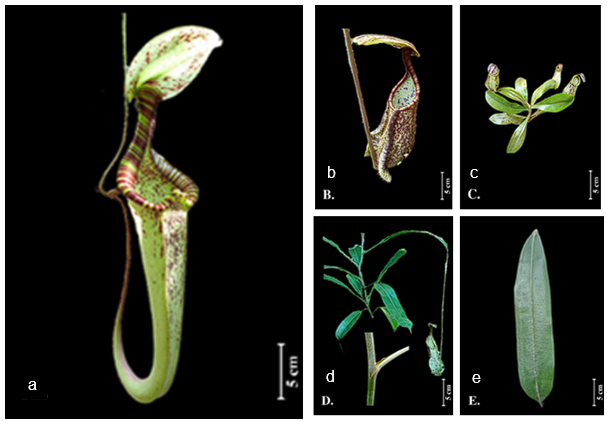
Kantong semar (Nepenthes spp.) merupakan tumbuhan karnivora yang tumbuh subur di Taman Wisata Alam Bukit Tangkiling (TWAB), Palangka Raya, Kalimantan Tengah. Penelusuran terhadap basis data keanekaragaman hayati global dan literatur terkait tidak menemukan catatan keberadaan Nepenthes sebelumnya di kawasan ini. Penelitian ini bertujuan untuk mendokumentasikan dan menyediakan catatan dasar spesies Nepenthes yang terdapat di TWAB. Penelitian dilakukan dari Maret hingga Mei 2022 menggunakan metode eksplorasi dan pengambilan sampel purposif untuk mengumpulkan spesimen tumbuhan. Tiga spesies, yaitu Nepenthes gracilis Korth, Nepenthes mirabilis (Lour.) Druce, dan Nepenthes rafflesiana Jack, tercatat di berbagai habitat, termasuk hutan semak belukar, hutan kerangas, hutan sekunder, dan hutan gambut, semuanya berada di bawah 100 m di atas permukaan laut. Temuan ini berkontribusi pada inventarisasi spesies TWAB dan berfungsi sebagai referensi ilmiah untuk strategi pemantauan dan pengelolaan ekologi di masa mendatang yang bertujuan menjaga kualitas habitat dan mendukung upaya konservasi Nepenthes jangka panjang di wilayah tersebut.
Kata kunci: habitat, catatan spesies, kantong semar, Nepenthes, Kalimantan
Unduhan
Referensi
Agustiorini, S., Rizqiani S., & Effendi, S. (2022). Wild pitcher plant (Nepenthes: Nepenthaceae) in lowland of Tanjung Selor: a notes of diversity, conservation and threats. Jurnal Biologi Tropis, 22(2), 534–540. http://dx.doi. org/10.29303/jbt.v22i2.3378
Bauer, U., Di Giusto, B., Skepper, J., Grafe, T. U., & Federle, W. (2012). With a flick of the lid: a novel trapping mechanism in Nepenthes gracilis pitcher plants. PLoS ONE, 7(6), 1–7. https://doi.org/10.1371/journal. pone.0038951
Benz, M. J., Gorb, E. V., & Gorb, S. N. (2012). Diversity of the slippery zone microstructure in pitchers of nine carnivorous Nepenthes taxa. Arthropod-Plant Interactions, 6(1), 147–158. https://doi.org/10.1007/ s11829-011-9171-2
Clarke, C. M. (1997). Nepenthes of Borneo. In K. Wong (Ed). Kota Kinabalu: Natural History Publication (Borneo).
Dančák, M., Majeský, E., Čermák, V., Golos, M. R., Płachno, B. J., & Tjiasmanto, W. (2022). First record of functional underground traps in a pitcher plant: Nepenthes pudica (Nepenthaceae), a new species from North Kalimantan, Borneo. PhytoKeys, 201, 77–97. https://doi.org/ 10.3897/phytokeys. 201.82872
Dewi, L., Haryono, A., & Gunawan, Y. E. (2020). Distribusi Nepenthes spp. di hutan Kalampangan [Distribution of Nepenthes spp. in Kalampangan forest]. Journal of Environment and Management, 1(2), 164–168. https://doi.org/10. 37304/jem.v1i2. 1753
Dino, Astiani, D., & Kartikawati, S. M. (2016). Studi keanekaragaman dan kondisi tempat tumbuh kantong semar (Nepenthes spp.) di kawasan danau Sebedang kecamatan Sebawi kabupaten Sambas [Study of diversity and conditions of the place of growing pitcher plant (Nepenthes spp.) in Sebedang lake the district of Sebawi Sambas regency]. Jurnal Hutan Lestari, 4(3), 371–379. https://doi.org/10.26418/jhl.v4i3.16369
Fitri, M., & Patana, P. (2015). Keanekaragaman jenis kantung semar (Nepenthes spp.) di kawasan suaka margasatwa Siranggas kabupaten Pakpak Bharat [Diversity of pitcher plant species (Nepenthes spp.) in the Siranggas wildlife sanctuary area, Pakpak Bharat regency]. Peronema Forestry Science Journal, 4(2), 224–232.
Hidayat, S., Helmanto, H., Dodo, Purnomo, D. W., & Supriyatna, I. (2018). Habitat of Nepenthes spp. in the area of Sampit botanic gardens, Central Kalimantan, Indonesia. Biodiversitas, 19(4), 1258–1265. https://doi.org/10.13057/biodiv/d190411
Kissinger, K., Zuhud, E. A. M., Darusman, L. K., & Siregar, I. Z. (2015). Analisis fungsi Nepenthes gracilis Korth. terhadap lingkungan hutan kerangas [Analysis of the function of Nepenthes gracilis Korth. on the heath forest environment]. Jurnal Hutan Tropis, 3(1), 61–66.
Lam, W. N., Lai, H. R., Lee, C. C., & Tan, H. T. W. (2018). Evidence for pitcher trait-mediated coexistence between sympatric Nepenthes pitcher plant species across geographical scales. Plant Ecology & Diversity, 11(3), 283–294. https://doi.org/10.1080/17550874.2018.1517831
Lestariningsih, N., & Setyaningsih, D. (2017). Explorative study of tropical pitcher plants (Nepenthes sp.) types and insects that trapped inside in Sebangau national park Palangka Raya Central Kalimantan. Journal of Physics: Conference Series, 795, 012062. https://doi.org/10.1088/1742-6596/ 755/1/011001
Mansur, M. (2007a). Nepenthes, kantong semar yang unik [Nepenthes, the unique pitcher plant]. Cet. 3. Jakarta: Penebar Swadaya.
Mansur, M. (2007b). Keanekaragaman jenis Nepenthes (kantong semar) dataran rendah di Kalimantan Tengah [Diversity of lowland Nepenthes (pitcher plants) species in Central Kalimantan]. Berita Biologi, 8, 15. http://e-journal.biologi.lipi.go.id/index.php/berita_biologi/article/view/1898
Mansur, M. (2010). Analisis populasi Nepenthes spp. di hutan rawa gambut, Kalampangan, Kalimantan Tengah [Population analysis of Nepenthes spp. in peat swamp forest, Kalampangan, Central Kalimantan]. Jurnal Tekniknologi Lingkungan BPPT, 11(1), 33–38. https://doi.org/10.29122/jtl.v11i1.1220
Mansur, M. (2013). Tinjauan tentang Nepenthes (Nepenthaceae) di Indonesia [A review of Nepenthes (Nepenthaceae) in Indonesia]. Berita Biologi, 12(1), 1–7.
Mansur, M., Brearley, F. Q., Esseen, P. J., Rode-Margono, E. J., & Tarigan, M. R. M. (2021). Ecology of Nepenthes clipeata on Gunung Kelam, Indonesian Borneo. Plant Ecology & Diversity, 14(3–4), 195–204.
McPherson, S., & Robinson, A. (2012). Field guide to the pitcher plants of Sulawesi (Redfern's field guides to pitcher plants). Dorset, UK: Redfern Natural History Productions.
Moran, J. A., Gray, L. K., Clarke, C., & Chin, L. (2013). Capture mechanism in Palaeotropical pitcher plants (Nepenthaceae) is constrained by climate. Annals of Botany, 112(7), 1279–1291. https://doi.org/10.1093/aob/ mct195
Murni, S., Rahmawati, L., & Nisa, K. (2020). Jenis dan karakteristik tumbuhan kantong semar (Nepenthes spp.) di kawasan Burni Ramung kecamatan Putri Betung kabupaten Gayo Lues [Types and characteristics of pitcher plants (Nepenthes spp.) in the Burni Ramung area, Putri Betung district, Gayo Lues regency]. Prosiding Seminar Nasional Biotik 2020. hlm. 216–225. https://jurnal.ar-raniry.ac.id/index.php/PBiotik/article/view/9638/5425
Murphy, B., Forest, F., Barraclough, T., Rosindell, J., Bellot, S., Cowan, R., Golos, M., Jebb, M., & Cheek, M. (2020). A phylogenomic analysis of Nepenthes (Nepenthaceae). Molecular Phylogenetics and Evolution, 144(11), 106668. https://doi.org/10.1016/j.ympev.2019.106668
Rizki, M., Wardhana, V. W., Mawardin, M., & Sunariyati, S. (2021). Diversity of semar pockets (Nepenthes sp.) at Palangka Raya University. Bioeduscience, 5(2), 159–165. https://doi.org/10.22236/j.bes/526495
Rugayah, Widjaja, E. A., & Praptiwi (2005). Pedoman pengumpulan data keanekaragaman flora [Guidelines for collecting data on flora diversity]. Bogor: Pusat Penelitian Biologi, LIPI.
Sunariyati, S., Wardhana, V. W., & Rizki, M. (2022). Vegetasi habitat Nepenthes sp. di hutan gambut kampus Universitas Palangka Raya, Kalimantan Tengah [Vegetation habitat of Nepenthes sp. in the peat forest of the Palangka Raya University campus, Central Kalimantan]. Jurnal Biosilampari: Jurnal Biologi, 5(1), 41–49. https://doi.org/10.31540/biosilampari.v5i1.1849
Thorogood, C. J., Bauer, U., & Hiscock, S. J. (2018). Convergent and divergent evolution in carnivorous pitcher plant traps. New Phytologist, 217(3), 1035–1041. https://doi.org/10.1111/nph.14879
Unduhan
Diterbitkan
Cara Mengutip
Terbitan
Bagian
Lisensi
Hak Cipta (c) 2025 Buitenzorg: Journal of Tropical Science

Artikel ini berlisensiCreative Commons Attribution-ShareAlike 4.0 International License.
The article is licensed under a Creative Commons Attribution-ShareAlike 4.0 International License (CC BY-SA), which allows both Authors and Readers to copy and distribute the material in any format or medium, as well as modify and create derivative works from it for any purpose, provided that appropriate credit is given (by citing the article or content), a link to the license is provided, and it is indicated if any changes were made. If the material is modified or used to create derivative works, the contributions must be distributed under the same license as the original.