In Vitro Antibacterial Activity and Preliminary Cytotoxicity of White Turmeric (Curcuma zedoaria) Kombucha
Abstract
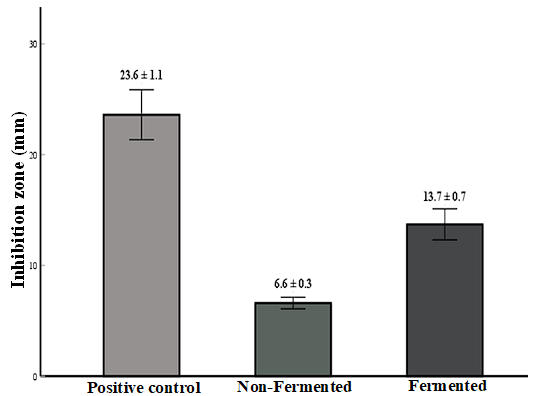
White turmeric (Curcuma zedoaria) contains bioactive compounds with antibacterial and cytotoxic potential; however, the quantity of these compounds and their biological activity remain relatively low. Fermentation can enhance these properties by promoting microbial bioconversion. This study evaluated the total flavonoid content as well as antibacterial and cytotoxic activities of C. zedoaria rhizomes fermented using a Symbiotic Culture of Bacteria and Yeast (SCOBY). Antibacterial activity was evaluated against Escherichia coli and Staphylococcus aureus using the disk diffusion method, while cytotoxic activity was analyzed using the Brine Shrimp Lethality Test (BSLT). The results showed that fermentation increased the total flavonoid content by 64% and substantially improved antibacterial performance, producing inhibition zones of 13.7±0.7 mm for E. coli and 12.8±0.4 mm for S. aureus, more than double those of the non-fermented white turmeric. Cytotoxic activity also increased, as indicated by a lower LC50 value (145.3 µg/ml) compared to the non-fermented white turmeric (1,381.8 µg/ml). Overall, the findings demonstrate that fermentation significantly enhances the antibacterial and cytotoxic activities of white turmeric.
Keywords: bioactivity enhancement, fermentation, functional beverage, SCOBY, white turmeric
Downloads
References
Antolak, H., Piechota, D., & Kucharska, A. (2021). Kombucha tea: a double power of bioactive compounds from tea and symbiotic culture of bacteria and yeast (SCOBY). Antioxidants, 10, 1541. https://doi.org/10.3390/antiox10101541
Association of Official Analytical Chemists (2007). Official methods of analysis of the Association of Official Analytical Chemists. 18th ed. Maryland, US: The Association of Official Agricultural Chemists.
Atthalia, V. (2024). Skrining dan uji sitotoksisitas berbagai aksesi kayu ulin (Eusideroxylon zwageri) dari Kalimantan [Screening and cytotoxicity testing of various ironwood (Eusideroxylon zwageri) accessions from Kalimantan]. [undergraduate thesis] Bogor: Institut Pertanian Bogor.
Balde, E. S., Camara, A. K., Traoré, M. S., Baldé, N. M., Megalizzi, V., Pieters, L., & Balde, A. M. (2019). The hypoglycemic and cytotoxic activity of the leaf extract of Combretum glutinosum Perr. ex DC. Journal of Pharmacognosy and Phytochemistry, 8(4), 2230–2237.
Bhattacharya, D., Bhattacharya, S., Patra, M. M., Chakravorty, S., Sarkar, S., Chakraborty, W., Koley, H., & Gachhui, R. (2016). Antibacterial activity of polyphenolic fraction of kombucha against enteric bacterial pathogens. Current Microbiology, 73(6), 885–896. https://doi.org/10.1007/s00284-016-1136-3
Budiansyah, A., Haroen, U., Syafwan, S., & Kurniawan, K. (2023). Antioxidant and antibacterial activities of the rhizome extract of Curcuma zedoaria extracted using some organic solvents. Journal of Advanced Veterinary and Animal Research, 10, 347–360. https://doi.org/10.5455/javar.2023.j687
Burapan, S., Kim, M., Paisooksantivatana, Y., Eser, B. E., & Han, J. (2020). Thai Curcuma species: antioxidant and bioactive compounds. Foods, 9(9), 1219. https://doi.org/10.3390/foods9091219
Chtibi, H., Harboul, K., Benali, T., Bouyahya, A., Abdelamjid, K., Louahlia, S., Chew, J., Ming, L. C., & Hammani, K. (2023). Comparative study of antibacterial activity of Cistus ladanifer L. leaves extracted by ultrasound-assisted extraction and maceration. Progress in Microbes & Molecular Biology, 6(1). https://doi.org/10.36877/pmmb.a0000394
da Silva Júnior, J. C., Mafaldo, Í. M., de Lima Brito, I., & de Magalhães Cordeiro, A. M. T. (2022). Kombucha: Formulation, chemical composition, and therapeutic potentialities. Current Research in Food Science, 5, 360–365. https://doi.org/10.1016/j.crfs.2022.01.023
de Lima, A. S. L., de Medeiros Felipe, A. T., de Oliveira Paiva, E. M., Medeiros, R. D., de Sousa Junior, F. C., Matsui, K. N., Zucolotto, S. M., da Silva Pedrini, M. R. (2025). Fermentation of passion fruit leaf tea with Kombucha inoculum: An upcycling approach for the development of functional fermented beverages. Food Research International, 218, 116870. https://doi.org/10.1016/j.foodres.2025.116870
Donadio, G., Mensitieri, F., Santoro, V., Parisi, V., Bellone, M. L., De Tommasi, N., Izzo, V., & Dal Piaz, F. (2021). Interactions with microbial proteins driving the antibacterial activity of flavonoids. Pharmaceutics, 13(5), 660. https://doi.org/10.3390/pharmaceutics13050660
Dwiputri, M. C., & Feroniasanti, Y. M. L. (2019). Effect of fermentation to total titrable acids, flavonoid and antioxidant activity of butterfly pea kombucha, IOP Conference Series: Journal of Physics, 1241, 012014. https://doi.org/10.1088/1742-6596/1241/1/012014
Filipe, M. S., Isca, V. M., Ntungwe, E., Princiotto, S., Díaz-Lanza, A., & Rijo, P. (2022). Lethality bioassay using Artemia salina L. Journal of Visualized Experiments, 188. https://doi.org/10.3791/64472
Hamidi, M., Jovanova, B., & Kadifkova Panovska, T. (2014). Toxicological evaluation of the plant products using brine shrimp (Artemia salina L.) model. Macedonian Pharmaceutical Bulletin, 60, 9–18. https://doi.org/10.33320/maced.pharm.bull.2014.60.01.002
Hasanah, U., Rosdiana, D., & Syaefudin, S. (2017). Antibacterial activity of ethanol extract from stem bark and leaves of berenuk (Crescentia cujete L.). Current Biochemistry, 4(1), 29–35. https://doi.org/10.29244/cb.11.1.2
Herman, A., & Herman, A. P. (2023). Biological activity of fermented plant extracts for potential dermal applications. Pharmaceutics, 15(12), 2775. https://doi.org/10.3390/pharmaceutics15122775
Jayabalan, R., Malbaša, R. V., Lončar, E. S., Vitas, J. S., & Sathishkumar, M. (2014). A review on kombucha tea—microbiology, composition, fermentation, beneficial effects, toxicity, and tea fungus. Comprehensive Reviews in Food Science and Food Safety, 13(4), 538–550. https://doi.org/10.1111/1541-4337.12073
Jomova, K., Alomar, S. Y., Valko, R., Liska, J., Nepovimova, E., Kuca, K., & Valko, M. (2025). Flavonoids and their role in oxidative stress, inflammation, and human diseases. Chemico-Biological Interactions, 413, 111489. https://doi.org/10.1016/j.cbi.2025.111489
Jubair, N., Mogana, R., Fatima, A., Mahdi, Y. K., & Abdullah, N. H. (2022). Evaluation of catechin synergistic and antibacterial efficacy on biofilm formation and acrA gene expression of uropathogenic E. coli clinical isolates. Antibiotics (Basel), 11(9), 1223. https://doi.org/10.3390/antibiotics11091223
Khan, T., Sankhe, K., Suvarna, V., Sherje, A., Patel, K., & Dravyakar, B. (2018). DNA gyrase inhibitors: progress and synthesis of potent compounds as antibacterial agents. Biomedicine & Pharmacotherapy, 103, 923–938. https://doi.org/10.1016/j.biopha.2018.04.021
Kumar, V., & Joshi, V. (2016). Kombucha: technology, microbiology, production, composition and therapeutic value. International Journal of Food Fermentation Technology, 6, 13–24. https://doi.org/10.5958/2277-9396.2016.00022.2
Kurokawa, H., Ito, H., Matano, D., Terasaki, M., & Matsui, H. (2022). Acetic acid enhances the effect of photodynamic therapy in gastric cancer cells via the production of reactive oxygen species. Journal of Clinical Biochemistry and Nutrition, 71(3), 206–211. https://doi.org/10.3164/jcbn.22-34
Maciel, P. F., & Steppe, M. (2017). Determination of water content in tea samples of Cymbopogon citratus S., Matricaria recutita L., Mentha spp. and Pimpinella anisum L. through gravimetric and thermogravimetric methods. Drug Analytical Research, 1(2), 53–60. https://doi.org/10.22456/2527-2616.79223
Marliani, L., Anandari, Y., & Budiana, W. (2017). Pengaruh pelarut, waktu dan suhu ekstraksi terhadap kandungan senyawa flavonoid dan kurkuminoid ekstrak rimpang temu putih (Curcuma zedoaria [Christm.] Roscoe) [The effect of solvent, time and extraction temperature on the content of flavonoid and curcuminoid compounds in white turmeric (Curcuma zedoaria [Christm.] Roscoe) rhizome extract]. Jurnal Farmasi Galenika, 4(1), 35–39. Retrieved from https://journal.bku.ac.id/jfg/index.php/jfg/article/view/84
Ministry of Health of the Republic of Indonesia (2014). Farmakope Indonesia Edisi V [Indonesian Pharmacopoeia 5th Ed.]. Jakarta: Direktorat Jenderal Farmasi dan Alat Kesehatan.
Miranda, B., Lawton, N. M., Tachibana, S. R., Swartz, N. A., & Hall, W. P. (2016). Titration and HPLC characterization of kombucha fermentation: a laboratory experiment in food analysis. Journal of Chemical Education, 93(10), 1770–1775. https://doi.org/10.1021/acs.jchemed.6b00329
Mohammadi, B. M., Falahati-Anbaran, M., & Rohloff, J. (2021). Comparative analyses of phytochemical variation within and between congeneric species of willow herb, Epilobium hirsutum and E. parviflorum: contribution of environmental factors. Frontiers in Plant Science, 11, 595190. https://doi.org/10.3389/fpls.2020.595190
Morales, D., Gutiérrez-Pensado, R., Bravo, F. I., & Muguerza, B. (2023). Novel kombucha beverages with antioxidant activity based on fruits as alternative substrates. Lebensmittel-Wissenschaft & Technologie, 189, 115482. https://doi.org/10.1016/j.lwt.2023.115482
Oprica, L., Antohe, R., Verdes, A., & Grigore, M. (2019). Effect of freeze-drying and oven-drying methods on flavonoids content in two Romanian grape varieties. Revista de Chimie, 70(2), 491–494. https://doi.org/10.37358/RC.19.2.6941
Papadimitriou, K., Alegría, Á., Bron, P. A., de Angelis, M., Gobbetti, M., Kleerebezem, M., Lemos, J. A., Linares, D. M., Ross, P., Stanton, C., et al. (2016). Stress physiology of lactic acid bacteria. Microbiology and Molecular Biology Reviews, 80(3), 837–890. https://doi.org/10.1128/MMBR.00076-15
Papayrata, C., Chumroenphat, T., Saensouk, P., & Saensouk, S. (2024). Diversity of curcuminoids, bioactive compounds and antioxidant activities in three species of Curcuma. Tropical Journal of Pharmaceutical Research, 23(8), 1291–1298. https://doi.org/10.4314/tjpr.v23i8.8
Prasety, O. S., Soegianto, L., & Wijaya, S. (2019). Uji aktivitas antibakteri dan antibiofilm fraksi biji kelengkeng (Euphoria longan Lour. Steud.) terhadap Staphylococcus aureus ATCC 6538. Jurnal Farmasi Sains dan Terapan, 6(2), 84–90. https://doi.org/10.33508/jfst.v6i2.2235
Putri, C. W., Nuraini, Y., Polosoro, A., Enggarini, W., Helmanto, H., Magandhi, M., Satyawan, D., Hadiarto, T., Suminto, S., & Hadiarto, T. (2025). Diversity in antioxidant and anti-termite activities among ironwood (Eusideroxylon zwageri Teijsm. & Binn.) accessions from Indonesia. Journal of the Korean Wood Science and Technology, 53(4), 343–358. https://doi.org/10.5658/WOOD.2025.53.4.343
Rachmawati, N., Nurmeily, N., Yulistiana, D., Kurniawan, A., & Firdaus, F. (2021). Uji daya hambat dan toksisitas ekstrak daun jamblang (Syzygium cumini [L.] Skeels) terhadap pertumbuhan bakteri Staphylococcus epidermidis. Jurnal Biologi Indonesia, 17(1), 39–46. https://doi.org/10.47349/jbi/17012021/39
Rao, Y. (2024). Variation of the content and antioxidant activity of active substances in the kombucha fermentation of mulberry leaves. Highlights in Science Engineering and Technology, 91, 396–401. https://doi.org/10.54097/vajf7a54
Ryzhenko, N. O., & Kavetsky, K. (2017). Probit analysis for Cd, Pb, Cu, Zn phytotoxicity assessment. Biotechnologia Acta, 10(2), 67–74. https://doi.org/10.15407/biotech10.02.067
Safitri, W. N., & Irdawati, I. (2020). Antibacterial activities of kombucha tea from some types of variations of tea on Escherichia coli and Staphylococcus aureus. BioScience, 4(2), 197–206. https://doi.org/10.24036/0202042105679-0-00
Semenov, G. V., Krasnova, I. S., Suvorov, O. A., Shuvalova, I. D., & Posokhov, N. D. (2015). Influence of freezing and drying on phytochemical properties of various fruit. Biosciences Biotechnology Research Asia, 12(2), 1311–1320. http://dx.doi.org/10.13005/bbra/1786
Shevchuk, O. V., Vlasova, O. G., Shevchuk, L. V., & Stefkivska, Y. L. (2023). Determination of pesticide toxicity parameters using probit-analysis. Quarantine and Plant Protection, 2, 14–19. https://doi.org/10.36495/2312-0614.2023.2.14-19
Slika, H., Mansour, H., Wehbe, N., Nasser, S. A., Iratni, R., Nasrallah, G., Shaito, A., Ghaddar, T., Kobeissy, F., & Eid, A. H. (2022). Therapeutic potential of flavonoids in cancer: ROS-mediated mechanisms. Biomedicine & Pharmacotherapy, 146, 112442. https://doi.org/10.1016/j.biopha.2021.112442
Stephenus, F. N., Benjamin, M. A. Z., Anuar, A., & Awang, M. A. (2023). Effect of temperatures on drying kinetics, extraction yield, phenolics, flavonoids, and antioxidant activity of Phaleria macrocarpa (Scheff.) Boerl. (mahkota dewa) fruits. Foods, 12, 2859. https://doi.org/10.3390/foods12152859
Suminto, S., Huang, A. A., Hasanah, U., & Nurcholis, W. (2024). Optimizing solid-state fermentation for metabolite enrichment by Aspergillus tamarii on rice bran and wheat. Journal of Applied Biology & Biotechnology, 12(4), 195-202. https://doi.org/10.7324/JABB.2024.179836
Suminto, S., Setiawan, C. D., Nurcholis, W., Hasanah, U., & Trivadila, T. (2025). Optimization of Justicia gendarussa Burm.f. fermentation by Aspergillus oryzae based on total phenolic, total flavonoid, and antioxidant capacity responses. Journal of Applied Biology & Biotechnology, 13(4), 41–48. https://doi.org/10.7324/JABB.2025.235051
Syahbirin, G., Aditianingrum, K. A., & Mohamad, K. (2024). Acute toxicity of ethanol extract of Curcuma zedoaria Rosc (Zingiberaceae) rhizomes on brine shrimp larvae and zebrafish embryos. Jurnal Medika Veterinaria, 3(2), 41–46. https://doi.org/10.20473/jmv.vol7.iss1.2024.7-18
Thai, H. N., Camp, J. V., Smagghe, G., & Raees, K. (2014). Improved release and metabolism of flavonoids by steered fermentation processes: A review. International Journal of Molecular Sciences, 15(11), 19369–19388. https://doi.org/10.3390/ijms151119369
Thenuwara, G., Cui, X., Yao, Z., Javed, B., Naik, A. S., & Tian, F. (2024). Evaluating the health implications of kombucha fermented with Gardenia jasminoides teas: a comprehensive analysis of antioxidant, antimicrobial, and cytotoxic properties. Biochemistry, 4(4), 350–370. https://doi.org/10.3390/biochem4040018
Tourabi, M., Metouekel, A., Ghouizi, A. E. L., Jeddi, M., Nouioura, G., Laaroussi, H., Hosen, M. E., Benbrahim, K. F., Bourhia, M., Salamatullah, A. M., et al. (2023). Efficacy of various extracting solvents on phytochemical composition, and biological properties of Mentha longifolia L. leaf extracts. Scientific Reports, 13, 18028. https://doi.org/10.1038/s41598-023-45030-5
Uswatun, U., & Wijayanti, E. (2020). Toksisitas akut kombucha daun tin (Ficus carica) dengan metode Brine Shrimp Lethality Test (BSLT) [Acute toxicity of fig (Ficus carica) leaf kombucha using the Brine Shrimp Lethality Test (BSLT) method]. Jurnal Farmasi Medica, 3, 11. https://doi.org/10.35799/pmj.3.1.2020.28958
Valares, M. C., Sosa, D. T., Alías, G. J. C., & Chaves, L. N. (2016). Quantitative variation of flavonoids and diterpenes in leaves and stems of Cistus ladanifer L. at different ages. Molecules, 21(3), 275. https://doi.org/10.3390/molecules21030275
Yasi, R. M., Harsanti, R. S., & Larasati, T. (2022). The effect of simplicia drying method on the acquisition of active compound levels of grinting grass simplicia extract (Cynodon dactylon [L.] Pers.). Berkala Sainstek, 10(3), 147. https://doi.org/10.19184/bst.v10i3.32309
Zubaidah, E., Kusmiyati, N., Arum, M. S., Hasfiani, Y., & Sujuti, H. (2025). Kombucha based on Javanese turmeric (Cucurma zanthorrhiza and Cucurma zedoaria): Effect of various concentrations and antioxidant activity. El-Hayah Jurnal Biologi, 10(2), 88. https://doi.org/10.18860/elha.v10i2.35542
Zubaidah, E., Putri, Z. M., Sujuti, H., Rahayu, A. P., & Ardyati, T. (2024). Physicochemical characteristics of kombucha based on various concentration of white turmeric (Curcuma zedoaria [Berg.] Roscoe). Biocatalysis and Agricultural Biotechnology, 56, 102998. https://doi.org/10.1016/j.bcab.2023.102998
Downloads
Published
How to Cite
Issue
Section
License
Copyright (c) 2025 Buitenzorg: Journal of Tropical Science

This work is licensed under a Creative Commons Attribution-ShareAlike 4.0 International License.
The article is licensed under a Creative Commons Attribution-ShareAlike 4.0 International License (CC BY-SA), which allows both Authors and Readers to copy and distribute the material in any format or medium, as well as modify and create derivative works from it for any purpose, provided that appropriate credit is given (by citing the article or content), a link to the license is provided, and it is indicated if any changes were made. If the material is modified or used to create derivative works, the contributions must be distributed under the same license as the original.